Between Two Slices: The Toastie Test for a Neighbourhood Cafe-Bar in 2026
A toastie is the most democratic thing on a cafe-bar menu. It does not need a launch, a hashtag or a fermentation jar. It needs bread, cheese, heat and someone paying attention. That is why it is such a useful measure of a neighbourhood venue. In 2026, when menus are crowded with small plates and prices are under pressure, a well-made sandwich tells you more about a place than any chalkboard manifesto. It tells you whether the kitchen is cooking for the room it actually has, or for an imaginary reviewer who never comes back.
The sandwich nobody puts on the specials board
Most cafe-bars have a toastie. Fewer have a toastie they would defend. It sits near the bottom of the menu, between the soup and the cake, and is often treated as the safe option for children, hungover adults and anyone who cannot face a salad. That is a mistake. The toastie is the item most likely to be ordered by a first-time visitor, a returning regular and a tradesperson on a break. It crosses age groups, appetites and times of day. If it is careless, people notice. If it is good, they come back.
A neighbourhood cafe-bar is not a restaurant with a local postcode. It is a room that has to work from the first flat white to the last glass of wine. The toastie is one of the few things on the menu that can plausibly belong to every part of that day. It can sit beside a coffee at 11am without feeling like a full meal. It can anchor a quick lunch at 1pm without demanding a reservation. It can even settle a small hunger at 4pm, when the kitchen is changing shifts and nobody wants a formal plate of anything.
Bread is the first honest receipt
Ask who makes the bread. A cafe-bar that can name its bakery, and say when the delivery lands, is usually a cafe-bar that knows what it is doing. The bread for a toastie needs to be sturdy but not tough. A very crusty sourdough can be wonderful on a cheese board and brutal in a toastie; it scrapes the roof of your mouth and refuses to yield to the filling. The best toastie bread is often the least fashionable: a good white tin loaf or a softer sourdough with a tight crumb. It should be cut thick enough to hold, thin enough to crisp.
Bread also tells you about freshness. A toastie made with bread that arrived this morning tastes different from one made with a loaf that has been sitting in a plastic bag since Tuesday. You can usually feel it in the first bite. The crust should shatter slightly, not bend like leather. The inside should be soft enough to compress around the cheese, not so dry that it drinks the butter. If the bread is good, the sandwich has a chance. If the bread is an afterthought, no amount of truffle oil will save it.
The cheese blend is a small act of judgement
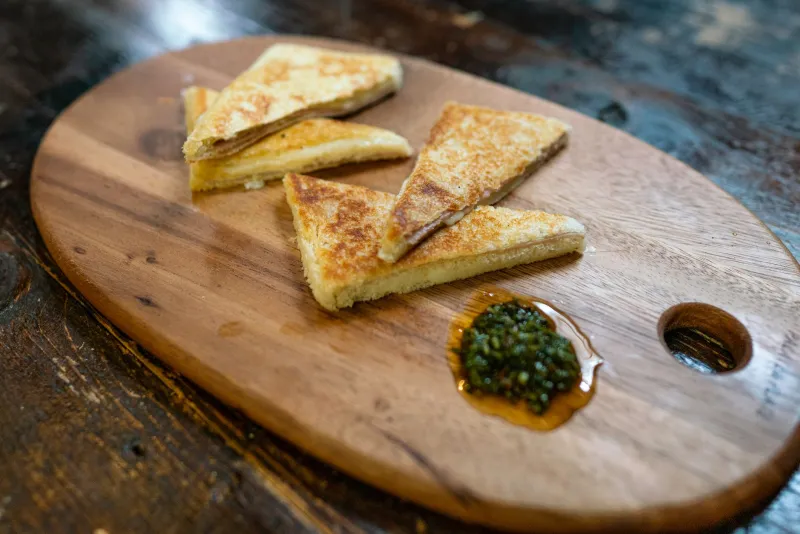
Cheese is where a cafe-bar shows its character. Cheddar alone can be sharp and oily. A little Red Leicester adds colour and a savoury edge. A spoon of something soft, such as a mild blue or a creamy local cheese, can bring richness without turning the toastie into a puddle. The blend should be grated, not sliced, so it melts evenly and does not leave cold patches in the corners. It should be generous but not reckless. A toastie that leaks half its filling onto the plate is not indulgent; it is badly built.
The same goes for everything else. A few good things are better than many average ones. Ham and cheese. Cheese and onion. Cheese, leek and mustard. A thin layer of Branston pickle or a dab of HP Sauce can do more than a fistful of herbs. The filling should be hot through, seasoned properly and restrained enough that the bread and cheese still matter. A toastie with five components is a plate pretending to be a sandwich. A toastie with two or three good things is a proper lunch.
The 11am handover and the 1pm exam
The toastie has to survive two very different audiences. At 11am, it is a coffee companion. It sits beside a flat white, a laptop and a half-finished conversation. It needs to be neat, quick and not too heavy. At 1pm, it is lunch. It arrives with a small salad, a few crisps or a cup of soup, and it has to satisfy someone who has walked in from the rain with a real appetite. The same sandwich has to work in both shifts. That is why overcomplicated fillings fail. They are too much at 11am and too fiddly at 1pm.
The best neighbourhood cafe-bars understand this rhythm. They do not treat the toastie as a leftover from the breakfast menu or a placeholder until the evening small plates come out. They give it a proper recipe, a proper price and a proper place in the day. In 2026, with menus chasing trends and costs rising, that is a quiet statement of values. It says the everyday customer matters. It says the kitchen can do simple things well. It says the place is confident enough not to hide behind garnish.
A toastie is a price, a portion and a promise
A toastie can be excellent value and still feel expensive if it is thin, greasy or served with a sigh. It can also cost more than you expected and feel entirely fair if it is made with good bread, proper cheese and a bit of care. The price has to match the promise. If a toastie costs as much as a main course, it needs to eat like one. If it is cheap, it still needs to be made as if someone is watching. There is no shame in a modest sandwich. There is shame in a careless one.
Service matters here too. Staff should know what is in the toastie, whether it contains mustard, and whether the bread is gluten-free. They should know if the cheese blend is vegetarian. They should be able to say what the soup is without disappearing to ask the kitchen. These are small things, but they are the same small things that make a neighbourhood cafe-bar feel trustworthy. A toastie is not a test of culinary ambition. It is a test of attention.
The Pear Tree checklist for judging a local toastie
- Bread: fresh, named supplier, thick enough to hold and crisp enough to shatter.
- Cheese: grated, melted evenly, not split or pooling in the middle.
- Filling: hot through, seasoned, and restrained enough to stay inside the sandwich.
- Structure: no leakage at the edges, no soggy base, no dry corners.
- Timing: served promptly, not held under a lamp until the cheese has given up.
- Condiments: something sharp on the side or inside, not a decorative ramekin of nothing.
- Price: honest for the portion, the ingredients and the room you are sitting in.
- Service: staff who know what is in it and seem pleased you ordered it.
- The plate: a small salad or a few crisps are fine; a mountain of garnish is not a substitute for a good sandwich.
What the empty plate tells you
A great toastie does not need to be clever. It needs to be warm, crisp, cheesy and made by someone who understands that a sandwich is still lunch. In a neighbourhood cafe-bar, that matters more than a changing menu of small plates. The toastie is the item that has to be good on a wet Tuesday, at 11am, for the person who only has twenty minutes and the person who has nowhere else to be. It is the quiet test of whether a place is looking after its own. And in 2026, that is still the best reason to walk through the door.